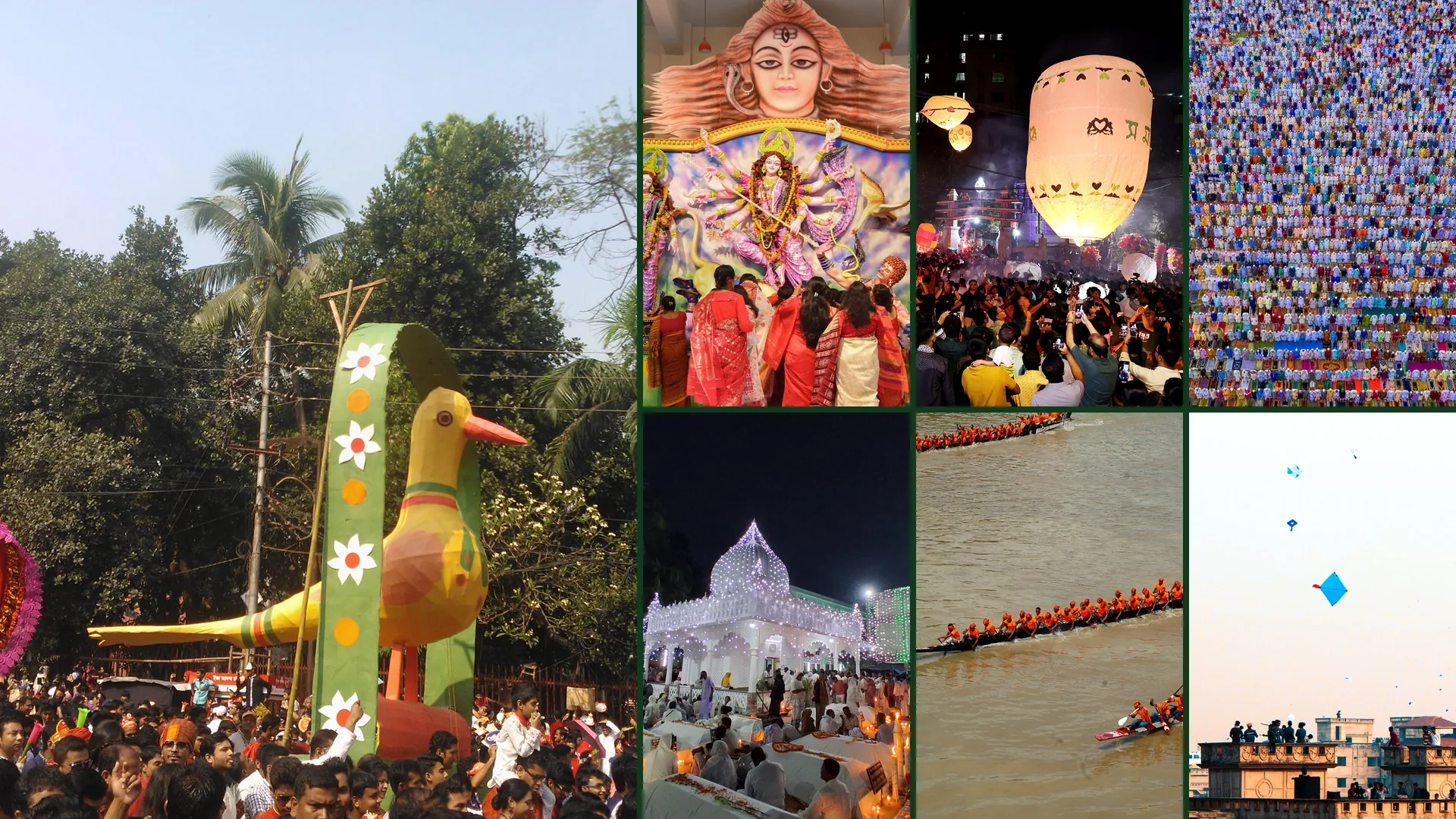
The biggest festivals in Bangladesh are Pohela Boishakh (Bengali New Year, 14 April), the two Eids, Durga Puja and the national days of 21 February, 26 March and 16 December. Visitors are welcome at almost all of them.
Most lists of festivals in Bangladesh stop at a name and a month. They rarely say whether a foreigner can join in, what the day actually feels like on the street, or why the date printed online is often wrong. This guide covers 22 festivals with that missing detail, and the events calendar keeps the confirmed dates for each year.
What Are the Biggest Festivals in Bangladesh?
Five celebrations stand above the rest, because almost the whole country stops for them. Pohela Boishakh belongs to everyone, Muslim, Hindu, Buddhist or Christian. The two Eids are the largest religious holidays, because about 90 per cent of Bangladeshis are Muslim. Durga Puja is the great Hindu festival, and the national days draw crowds to Dhaka’s memorials.
The table below gives the quick picture. The months are typical; lunar festivals move, which the section on dates explains.
| Festival | Type | Usual month | Best place to see it | Can visitors join? |
|---|---|---|---|---|
| Pohela Boishakh | Bengali New Year | 14 April | Ramna and Dhaka University | Yes, wear red and white |
| Eid al-Fitr | Muslim | Moves (March in 2026) | Any town, Chaand Raat markets | Watch and share food; prayers mostly men |
| Eid al-Adha | Muslim | Moves (May in 2026) | Neighbourhood streets | Yes, but expect sacrifice in public |
| Durga Puja | Hindu | September or October | Dhakeshwari Temple, Old Dhaka pandals | Yes, pandals welcome visitors |
| Ekushey February | National | 21 February | Central Shaheed Minar | Yes, barefoot with flowers |
| Independence Day | National | 26 March | National Martyrs’ Memorial, Savar | Yes, after the official tributes |
| Victory Day | National | 16 December | Savar and central Dhaka | Yes |
| Lalon Mela | Baul music | Spring and October | Cheuriya, Kushtia | Yes, all night |
| Buddha Purnima | Buddhist | April or May | Dhaka and Chattogram viharas | Yes, quietly |
| Christmas | Christian | 25 December | Churches of Dhaka | Yes |
Which Bengali Festivals Does Everyone Celebrate?
Bengali cultural festivals are the easiest for a visitor to join, because faith plays no part in them. They follow the Bangla calendar, which Bangladesh fixed to the Western one, so their dates barely move. As a result, colour, food and music matter more than ritual.
Pohela Boishakh, the Bengali New Year
Pohela Boishakh on 14 April is the one day every Bangladeshi celebrates together. Dhaka dresses in red and white, the Chhayanaut choir sings at dawn under the banyan tree at Ramna Batamul, and families eat panta bhat (soaked rice) with fried hilsa. Fairs called Boishakhi Mela spread across the country with crafts, toys and sweets.
Arrive early, because the crowds around Ramna build fast.
The great procession from the Faculty of Fine Arts at Dhaka University, with its giant masks and figures, is on UNESCO’s list of intangible cultural heritage as Mangal Shobhajatra. Since 2025 it has gone by other names: Barshabaran Ananda Shobhajatra in 2025 and Boishakhi Shobhajatra in 2026. The masks and the dawn start are unchanged.
Pohela Falgun and Basanta Utsab
Spring arrives on Pohela Falgun, 14 February, when Dhaka turns yellow and orange. Women wear marigold-coloured saris and flower crowns, and Bakultala at the Faculty of Fine Arts hosts music and dance from the morning. The same date is Valentine’s Day, so the parks are full of couples as well.
Shakrain, the Kite Day of Old Dhaka
Shakrain falls on the last day of Poush, 14 January. The rooftops of Shankhari Bazar, Sutrapur and Gendaria fill with kite fighters from morning until dark, and after sunset young men breathe fire for the crowds. Few tourists know about it, so a guide who can get you onto a rooftop makes all the difference.
Nabanna and the Winter Pitha Festivals
Nabanna is the harvest festival of new rice, held in villages in November and December when the aman crop comes in. Families make pitha, rice cakes steamed, fried or filled with date-palm molasses. In Dhaka, pitha festivals run through the winter, usually at the Shilpakala Academy and on university campuses.
Lalon Mela and the Bauls of Kushtia
The Lalon Mela gathers thousands of Baul singers at the shrine of the mystic poet Lalon Shah in Cheuriya, Kushtia. It happens twice a year, at the Dol Purnima full moon in spring and on Lalon’s death anniversary in October. The singing goes on all night; arrive by late afternoon to find space near the akhra, the open courtyard where most of the music happens.
Nouka Baich, the Boat Races
Nouka Baich is the season of long boat races on rivers swollen by the monsoon, mostly from August to October. Boats carrying dozens of rowers race to the rhythm of drums and songs, while thousands watch from the banks. However, races are local and often announced only a few days ahead.
National Days: 21 February, 26 March and 16 December
The three national days are solemn mornings that turn into cheerful afternoons. Each begins with tributes at a memorial before dawn or at sunrise, then becomes a family day out in flags and green and red clothes. Visitors are welcome, as long as they keep to the edges during the official ceremonies.
Wear something green or red and you will fit right in.
| National day | What it marks | Where to go | Visitor tip |
|---|---|---|---|
| Ekushey February, 21 February | The students killed in 1952 for the Bangla language | Central Shaheed Minar, Dhaka | Go after the midnight tributes; remove shoes near the monument |
| Independence Day, 26 March | The 1971 declaration of independence | National Martyrs’ Memorial, Savar | The memorial opens to the public after the state tribute |
| Victory Day, 16 December | Victory in the Liberation War | Savar, Suhrawardy Udyan | Expect road closures in central Dhaka |
Ekushey February has a reach far beyond Bangladesh. The idea of a day for mother languages came from Bangladesh, and UNESCO proclaimed International Mother Language Day in November 1999. The month also brings the Amar Ekushey book fair at Bangla Academy, which in 2027 starts early, in January.
How Is Eid Celebrated in Bangladesh?
Eid in Bangladesh is above all a family homecoming. Millions of people leave the cities to spend it in their home villages, so the festival feels quiet in Dhaka and busy everywhere else. Both Eids start with mass prayers in the morning and continue with new clothes, visits and a great deal of food.
Eid al-Fitr and Chaand Raat
Eid al-Fitr ends the fasting month of Ramadan. The night before, Chaand Raat (“moon night”), is the liveliest part for a visitor: markets stay open late, women queue for henna and the streets fill with last-minute shoppers. On the day, sweet vermicelli called shemai is served in every home.
So for a visitor, Chaand Raat is the night to be out.
Eid al-Adha and the Street Sacrifice
Eid al-Adha, known locally as Qurbani Eid, is when families sacrifice a cow or goat and share the meat with relatives and the poor. Cattle markets appear across Dhaka in the week before, and the sacrifice happens in the streets and courtyards on the first morning. It is a moving tradition. Still, squeamish visitors should know that blood in the gutters is part of the day.
Ramadan for Visitors
Ramadan is a month of fasting from dawn to sunset, and daily life slows down. Many local restaurants close by day or hang a curtain over the door. Hotels, however, keep serving. The reward comes at sunset, when iftar stalls fill the streets, with the famous Chawkbazar iftar market in Old Dhaka as the highlight.
Bishwa Ijtema at Tongi
Bishwa Ijtema is a huge Muslim congregation on the banks of the Turag river at Tongi, north of Dhaka, held in two phases in winter, usually in January or February. Its final prayer is one of the largest gatherings of Muslims anywhere. It is a religious event rather than a spectacle, so most visitors simply avoid the roads around Tongi that week.
Durga Puja and the Hindu Festival Year
Durga Puja is the high point of the Hindu year in Bangladesh, when thousands of pandals, or temporary shrines, appear across the country. The Hindu calendar adds pilgrimages and fairs that few outsiders see, from chariot festivals to river bathing.
Durga Puja
Durga Puja lasts five days in September or October. Each pandal houses a clay image of the goddess Durga, and evenings bring drumming, incense and crowds moving from one pandal to the next. The busiest in Dhaka are at Dhakeshwari Temple and in the lanes of Shankhari Bazar. On Bijoya Dashami, the last day, the images are carried to the rivers and immersed.
Rath Yatra in Dhamrai
The Dhamrai Rath Yatra is one of the oldest chariot festivals in Bengal, held in June or July. Devotees pull a towering wooden chariot through the town, and a fair runs for weeks afterwards. Dhamrai is about an hour from Dhaka, so it makes an easy day trip.
Langalbandh Ashtami Snan
At Langalbandh, on the Old Brahmaputra near Narayanganj, huge numbers of Hindu pilgrims bathe in the river on one spring morning, usually in March or April. It is one of the largest Hindu gatherings in Bangladesh, and the crowds are intense, so it suits experienced travellers best.
Rash Purnima: Kantajew and Dublar Char
The full moon of Rash Purnima in November brings two very different fairs. At the Kantajew Temple in Dinajpur, the finest terracotta temple in the country, a month-long Rash Mela begins. Far to the south, pilgrims sail into the Sundarbans for the Rash Mela on Dublar Char and a dawn bath in the sea, which needs forest permission and a boat.
When Are the Buddhist and Christian Festivals?
Buddhist festivals follow the full moons, and Christian ones follow the Western calendar. Both communities are small, so their celebrations are calmer. As a result, they are easier for visitors to see up close.
Buddha Purnima
Buddha Purnima marks the birth, enlightenment and death of the Buddha on the full moon of Baishakh, usually in May rather than April as many lists claim. In 2026 it fell on 1 May. Viharas in Dhaka and Chattogram hold prayers, light lamps and serve food to all comers.
Prabarana Purnima and Kathin Chibar Dan
Prabarana Purnima ends the monks’ three-month rains retreat in October, with lamps and sky lanterns called fanus released into the night. In the month that follows, Kathin Chibar Dan sees new robes offered to the monks. At Rajban Vihara in Rangamati, the robe is spun, dyed and woven within 24 hours.
Christmas in Dhaka
Christmas, called Boro Din (“the big day”), is a public holiday. Churches such as the Holy Rosary Church in Tejgaon, one of the oldest in Dhaka, hold midnight mass, and the Christian quarters decorate their lanes.
Big hotels put up trees and lights, which makes Dhaka surprisingly festive in late December.
Indigenous Festivals Few Visitors See
Bangladesh’s Indigenous peoples, from the hill communities of the southeast to the Garo of the north, have festivals of their own. Yet they are some of the most beautiful in the country, and the least known.
Boisabi: Biju, Sangrai and Boisuk
Boisabi is the New Year of the Chittagong Hill Tracts in mid-April. The Chakma float flowers on Kaptai Lake for Biju, and the Marma throw water at each other during Sangrai in Bandarban. Foreigners need official permission to visit the Hill Tracts, which takes one to two weeks to arrange.
Wangala, the Garo Harvest Festival
Wangala is the thanksgiving festival of the Garo people, held village by village from late October to December. Drummers and dancers honour the sun god for the harvest. The best-known gatherings are in Madhupur and Birishiri.
Manipuri Rash Leela in Kamalganj
On the night of Rash Purnima, the Manipuri community near Sreemangal performs the Rash Leela, a dance drama of Krishna and Radha that lasts until dawn. The costumes are extraordinary, and the setting among tea gardens makes it a highlight of a trip to Sylhet.
Why Festival Dates Change Every Year
Festival dates in Bangladesh come from five different calendars, so a date that is correct one year is wrong the next. The fixed Bangla festivals stay put. The lunar ones move, however, and some are confirmed only days in advance.
| Calendar | Festivals | How the date moves | When it is confirmed |
|---|---|---|---|
| Revised Bangla (fixed) | Pohela Boishakh, Pohela Falgun, Shakrain | Same date every year | Known years ahead |
| Western (Gregorian) | National days, Christmas | Same date every year | Known years ahead |
| Islamic lunar | Both Eids, Ramadan, Ashura | About 11 days earlier each year | The evening before, after the moon is sighted |
| Hindu lunar (panjika) | Durga Puja, Rath Yatra, Rash Purnima | Within a window of three to four weeks | Months ahead, in the almanac |
| Buddhist full moons | Buddha Purnima, Prabarana, Kathin | Within a window of about a month | Weeks ahead, by each vihara |
The Islamic year is about 11 days shorter than the Western year, which is why both Eids arrive earlier every year. In 2026 Eid al-Fitr fell in March, and by the end of the decade it will be in February. The national moon-sighting committee announces the exact day only the evening before.
The events calendar lists the confirmed or expected date of each festival for the coming months. So it is the place to check before booking flights.
Is It a Good Idea to Travel During Eid?
Travelling during Eid works only if you stay put. For about a week around each Eid, buses, trains and river launches are sold out, roads out of Dhaka are jammed, and many shops, restaurants and offices close. The government gives five to seven days of holiday, and many people take more.
Staying in Dhaka is a different story. The city empties, traffic disappears and a drive that takes two hours on a normal day can take twenty minutes. Hotels stay open, and a city tour on empty roads is a rare pleasure.
| Plan during Eid | Verdict |
|---|---|
| Touring between cities | Avoid: transport is full and prices rise |
| A few quiet days in Dhaka | Good: empty roads, calm city |
| Flying in or out | Fine, but book early and allow extra time |
| Seeing Eid celebrations | Best on Chaand Raat and the morning of Eid |
In short, see Eid in Dhaka and travel the week after.
Should You Plan Your Trip Around a Festival?
A festival can be the highlight of a trip, or the reason it goes wrong. That depends on the festival, and on how you like to travel.
A festival is likely to suit you if:
- You enjoy crowds, noise and colour, and do not mind being part of them
- You can keep a day or two of slack in your plans for a moving date
- You want photographs and moments most visitors never see
- You are happy to travel with a guide who knows where to stand and when to leave
You may be better off avoiding festival dates if:
- You dislike large crowds or have limited mobility
- Your trip is short and every day is planned around transport
- You want quiet heritage sites to yourself
- You are travelling during Eid and planning to cross the country
Neither list is absolute. A two-hour visit to Durga Puja pandals in Old Dhaka suits almost anyone, while a night at the Lalon Mela is wonderful for some people and exhausting for others.
How Should Visitors Behave at Festivals in Bangladesh?
Good manners at a festival come down to modest clothes, bare feet in sacred places and asking before you photograph. Bangladeshis are proud to share their festivals and will often invite a foreigner in, so a little care goes a long way.
When in doubt, ask first. The table covers the common situations.
| Situation | Do | Avoid |
|---|---|---|
| Clothing | Cover shoulders and knees; join in with festival colours | Shorts and sleeveless tops at religious events |
| Temples, pandals, viharas | Take off shoes, follow the queue | Touching images, offerings or worshippers |
| Shaheed Minar and memorials | Go barefoot near the monument | Climbing or posing on it |
| Photography | Ask before close portraits, stay quiet during prayers | Flash at ceremonies, blocking processions |
| Crowds | Keep valuables in a front zipped bag, agree a meeting point | Staying in the thickest crush, especially as a woman alone |
| Hill Tracts festivals | Apply for permission in advance | Arriving without approval |
For women, festival crowds in Dhaka can be very tight, and groping does happen in the densest moments. Staying near the edges, going with a group or a guide, and leaving before the peak hour all help. The guide to solo and female travel in Bangladesh covers this in more depth, and what to wear in Bangladesh explains dress for temples and mosques.
When Festival Plans Go Wrong
Most festival trips go smoothly, but the same few problems come up every year. Knowing them in advance, though, turns a ruined day into a minor change of plan.
- The date moves. Lunar festivals can shift by a day, and some local fairs change at short notice. A spare day in the itinerary solves it.
- Security cut-offs. In Dhaka, Pohela Boishakh and the national days come with bag checks, closed roads and an early end to outdoor events. Arriving after the cut-off means watching from far away.
- Strikes and rallies. Political rallies and hartals (general strikes) sometimes cluster around national days. They are usually announced in advance, and a local guide will reroute.
- Permits. A Hill Tracts festival without a permit is a festival seen from a checkpoint. Apply early, and keep to the approved route.
- Weather. Boat races and some river festivals depend on the monsoon. Heavy rain can cancel a race or flood the road to it.
Frequently Asked Questions
What Is the National Festival of Bangladesh?
Pohela Boishakh, the Bengali New Year on 14 April, is the closest thing to a national festival, because people of every faith celebrate it. Independence Day on 26 March and Victory Day on 16 December are the main national days.
Is Pohela Boishakh on the Same Day as in India?
Not always. Bangladesh fixed its Bangla calendar so that Pohela Boishakh always falls on 14 April. In West Bengal, the traditional almanac is still followed, so the Bengali New Year there falls on 14 or 15 April depending on the year.
Can Foreigners Visit Durga Puja Pandals?
Yes. Pandals are open to everyone, and visitors are usually welcomed warmly. Take off your shoes where others do, dress modestly and ask before photographing people at prayer. Evenings are the most atmospheric and also the most crowded.
Can Tourists Attend Eid Prayers?
Eid prayers are held in mosques and large open grounds, and they are mostly attended by men. A respectful foreign visitor can watch from the edge, but joining the prayer rows is for Muslims. Women visitors are better off watching the celebrations afterwards.
Are Restaurants Open During Ramadan?
Hotel restaurants and many places in Gulshan and Banani stay open during the day. Many local restaurants close until sunset or serve behind a curtain. Eating discreetly is polite, and the iftar markets at sunset are a highlight in their own right.
Do I Need a Permit for Festivals in the Chittagong Hill Tracts?
Yes. Foreign visitors need permission to enter Rangamati, Bandarban and Khagrachari, including for Boisabi and Kathin. Applications take one to two weeks. Some governments also advise against travel there, so check your own government’s advice first.
Is Holi Celebrated in Bangladesh?
Yes, though on a smaller scale than in India. Hindus celebrate Dol Jatra, the festival of colours, at the full moon in late February or March. The liveliest place is Shankhari Bazar in Old Dhaka, where coloured powder flies through the lanes.
What Should Women Wear to Festivals in Bangladesh?
Loose clothing that covers shoulders and knees works everywhere, and a scarf is useful at religious sites. Joining in with the festival colours is appreciated: red and white for Pohela Boishakh, yellow for Basanta Utsab. A salwar kameez is comfortable and easy to buy locally.
What Food Is Eaten at Festivals in Bangladesh?
Each festival has its own dishes. Pohela Boishakh means panta bhat with hilsa, Eid al-Fitr means shemai (sweet vermicelli), and winter festivals mean pitha (rice cakes). The guide to Bangladeshi food explains what to try and where.
Is Alcohol Part of Festivals in Bangladesh?
No. Alcohol plays no part in festivals in Bangladesh, and drinking in public is not acceptable. Foreign visitors can usually buy a drink only in licensed hotel bars and clubs. Festivals here are about food, music and family rather than drinking.
What Is the Best Month for Festivals in Bangladesh?
February is hard to beat, with Pohela Falgun and Ekushey February in pleasant weather. April brings Pohela Boishakh and Boisabi, and October or November brings Durga Puja, the Lalon Mela and Rash Purnima. The guide to the best time to visit covers the weather.
Are Festivals in Bangladesh Safe for Tourists?
Yes, for the most part. The main risks are crowds, pickpockets and traffic rather than violence. Security is heavy at the big Dhaka events. Keep valuables secure, stay at the edges of the densest crowds and read the guide on whether Bangladesh is safe.
How Far Ahead Should I Book for Durga Puja or Eid?
Book hotels and transport at least a month ahead for Durga Puja, and two months ahead if your trip overlaps an Eid. Seats on trains and river launches before Eid sell out within hours of going on sale, and car hire prices rise sharply.
Do I Need a Guide to Attend Festivals in Bangladesh?
Not for the big public events in Dhaka, but a guide makes a real difference. A guide knows when the crowds peak, which pandal or rooftop to head for, and how to explain the rituals. For the Hill Tracts, Dublar Char or the Lalon Mela, a local guide is almost essential.
What Happened to Mangal Shobhajatra?
The Pohela Boishakh procession at Dhaka University, listed by UNESCO in 2016 as Mangal Shobhajatra, has changed its name. In 2025 it was called Barshabaran Ananda Shobhajatra, and in 2026 Boishakhi Shobhajatra. The masks, the floats and the dawn start remain the same.
Is Christmas a Public Holiday in Bangladesh?
Yes. Christmas Day, 25 December, is a public holiday, known in Bangla as Boro Din. Churches in Dhaka hold midnight mass, and the big hotels put on decorations and festive meals for guests. However, most shops stay open as usual.
Planning a Trip Around a Festival
Festivals in Bangladesh show the country at its most open and joyful. That means red and white at Pohela Boishakh, drums at Durga Puja and all-night singing in Kushtia. So pick a festival that suits your travel style, and leave a spare day for moving dates. Also check the events calendar before booking.
The rest tends to take care of itself once you are in the crowd.