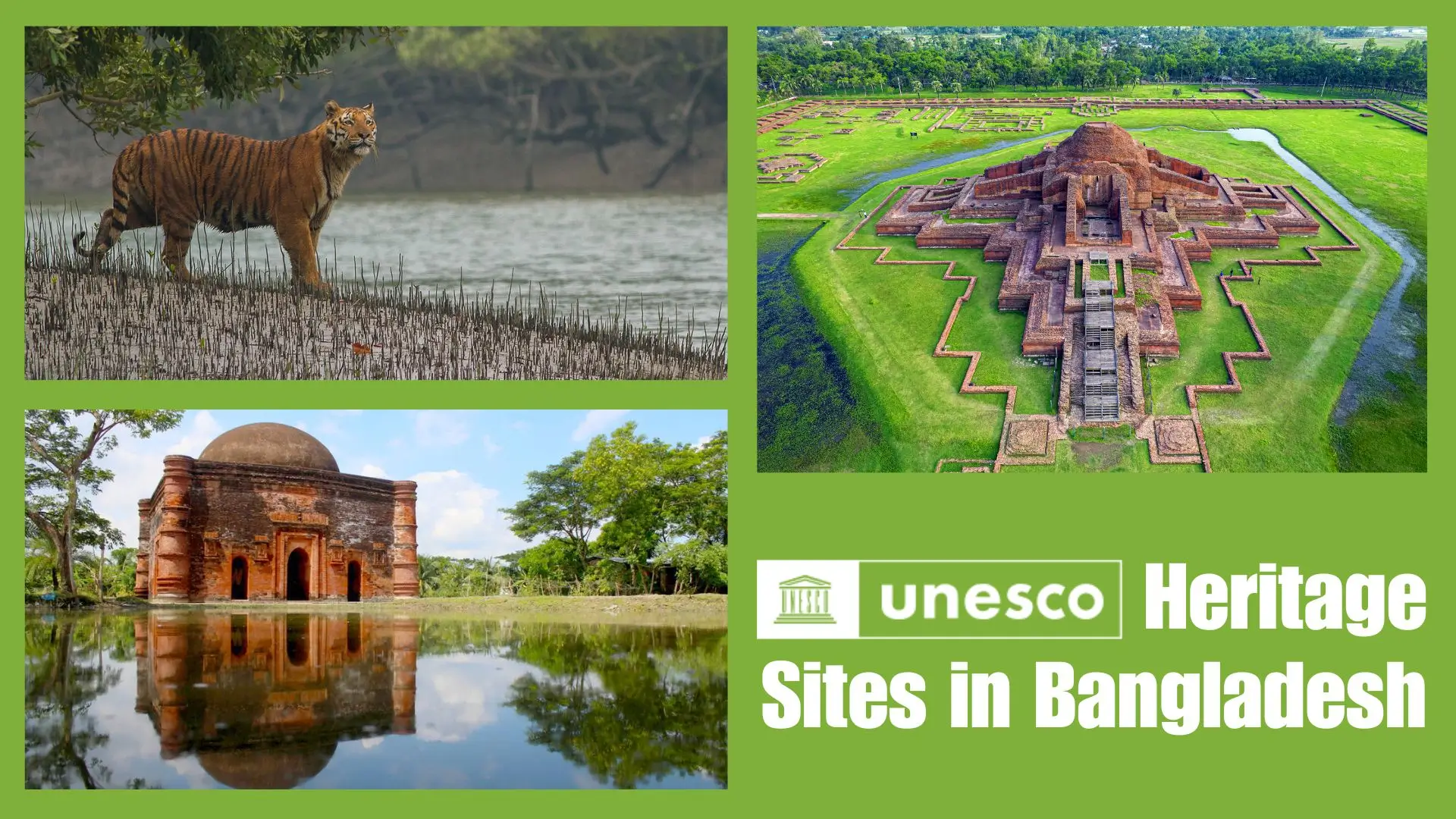
Bangladesh has three UNESCO World Heritage Sites: the Historic Mosque City of Bagerhat, the Buddhist Vihara at Paharpur and the Sundarbans mangrove forest. UNESCO also lists six living Bangladeshi traditions.
Most lists of UNESCO World Heritage Sites in Bangladesh stop at the three names. This guide goes further, because a traveller needs more than a list.
For each site you will find what you are looking at, why UNESCO chose it, how long it takes from Dhaka, and what to see nearby. Then comes the living heritage you can watch, hear and buy, seven sites that may be next, and a route that links all three in about a week.
Which Are the UNESCO World Heritage Sites in Bangladesh?
The two cultural sites were listed together in 1985, and the Sundarbans followed in 1997. They lie in different corners of the country, so the table helps you see how they fit into a trip.
| Site | Type | Listed | Where | From Dhaka | Time to allow |
|---|---|---|---|---|---|
| Historic Mosque City of Bagerhat | Cultural | 1985 | Bagerhat, southwest | About 4 to 5 hours by road | Half a day |
| Buddhist Vihara at Paharpur | Cultural | 1985 | Naogaon, northwest | About 6 to 7 hours by road, or fly to Rajshahi | 2 to 3 hours |
| The Sundarbans | Natural | 1997 | Southwest coast, shared with India | About 4 to 5 hours to Mongla, then by boat | One day at the edge, 2 to 3 days for the core |
Bagerhat and the Sundarbans are only an hour apart, so most travellers see them on the same trip. Paharpur, however, is in the far north, closer to Rajshahi and Bogura.
“Bangladesh may not be as popular as some other destinations in Asia, but in my humble opinion it is a beautiful country with amazing historical and cultural sights.”
Slobodan M, after an eight-day tour that included Bagerhat and the Sundarbans (Google, October 2026)
1. The Historic Mosque City of Bagerhat
Allow half a day, and come early, when the light on the old brick is softest.
Bagerhat is the remains of a whole city, founded in the 15th century by Khan Jahan Ali, a general who settled the edge of the mangroves. UNESCO describes it as a city of mosques, tombs, roads, bridges and water tanks spread over about 50 square kilometres. More than 50 of its monuments have been catalogued, and you can walk or drive between the best of them in a morning.
The Sixty Dome Mosque
The centrepiece is the Sixty Dome Mosque, or Shat Gombuj Masjid, the largest historic mosque in Bangladesh. Despite the name, the roof carries more than seventy low domes on around sixty slender stone pillars. Inside, the rows of arches and pillars create one of the most striking interiors in South Asia. Visitors are welcome outside prayer times, with shoes off and shoulders and knees covered.
The Rest of the Mosque City
A short drive away, the shrine of Khan Jahan Ali stands beside a large pond, where pilgrims still come to pray. The small Nine Dome Mosque and the single-domed Singair Mosque show the same brick and terracotta style on a smaller scale. Together they explain why UNESCO listed the city, not one building.
How to visit: Bagerhat is about four to five hours from Dhaka by road over the Padma Bridge, or about 40 minutes from Khulna. The sites are flat and easy to walk. Most travellers spend a morning here, then continue to the Sundarbans from Mongla, an hour away.
2. The Ruins of the Buddhist Vihara at Paharpur
Paharpur, or Somapura Mahavihara, was one of the great Buddhist monasteries south of the Himalayas. It was founded in the late 8th century by the Pala king Dharmapala and remained a centre of learning until the 12th century. UNESCO notes that its design influenced Buddhist temples as far away as Cambodia and Java.
If you see only one ancient site in Bangladesh, make it this one.
The scale is what stays with you. The monastery is a square about 280 metres on each side, lined with 177 monks’ cells, and in the middle rises a cross-shaped shrine of three terraces. Around its base runs a band of terracotta plaques showing gods, animals and scenes of daily life. Many are still in place; others are in the small site museum.
How to visit: Paharpur lies in Naogaon district, about six to seven hours from Dhaka by road. A faster way is a short flight to Rajshahi, then about two hours by car. The walk around the base of the shrine is flat, although the terraces themselves are fenced off. Allow two to three hours, including the museum.
Nearby: Paharpur is the heart of a region full of older history. Mahasthangarh, the oldest city found in Bangladesh, and the monastery ruins at Vasu Bihar are near Bogura. The terracotta temples of Puthia are near Rajshahi. Our Heritage Treasures of North Bengal tour covers them in four days.
3. The Sundarbans
The Sundarbans is the largest mangrove forest in the world, spread across the delta of the Ganges, Brahmaputra and Meghna. About 60 percent of it lies in Bangladesh. The World Heritage property covers three wildlife sanctuaries in the south of the forest, linked to India’s own Sundarbans site, listed in 1987.
There are no roads, so every visit is by boat.
Why UNESCO Chose It
UNESCO chose it for two reasons. It shows a delta still being made, as rivers lay down new land and mangroves move in. It is also one of the last great refuges of the Bengal tiger.
A 2024 survey by the Forest Department counted 125 tigers in the Bangladesh part. Sightings are rare, however, so most visitors settle happily for spotted deer, crocodiles, monkeys and kingfishers.
A Day at the Edge, or Days in the Core
There are two ways to see it. A day trip from Mongla reaches Karamjal, a forest station with a boardwalk and a small wildlife centre, and sometimes Harbaria. The World Heritage sanctuaries, such as Katka, are deeper south, and reaching them takes a boat trip of two or three days.
Foreign visitors need a forest permit, arranged with passport details before the trip. The guide to visiting the Sundarbans explains the boats, the routes and what to pack. For the full forest, see the Sundarbans Mangrove and Wildlife Expedition.
Which Famous Places Are Not UNESCO Sites?
Several famous places in Bangladesh are often described online as UNESCO sites, but they are not. The mix-ups come from the Tentative List, from intangible heritage, and from simple copying between websites. Here are the ones travellers ask about most.
- Lalbagh Fort in Dhaka is not a World Heritage Site, although Mughal forts around Dhaka are on the Tentative List.
- Mahasthangarh is on the Tentative List, not the World Heritage List.
- Kantajew Temple near Dinajpur, the finest terracotta temple in the country, is not a World Heritage Site.
- Cox’s Bazar beach is not a UNESCO site.
- Jamdani and Baul songs are UNESCO-listed, but as intangible heritage, which is a different list.
Still, these places are well worth visiting. Lalbagh Fort and Mahasthangarh, for example, are among the most rewarding sights in the country.
What Living Traditions Does UNESCO Recognise in Bangladesh?
UNESCO’s other list, the Intangible Cultural Heritage of Humanity, recognises traditions rather than places. Bangladesh has six on it, and the best part for travellers is that each one is still alive. You can watch it, hear it, or take it home.
Here is where to find each one.
| Tradition | Listed | Where to experience it |
|---|---|---|
| Baul songs | 2008 | Lalon Akhra, Kushtia, and village fairs |
| Jamdani weaving | 2013 | Weaving villages east of Dhaka |
| Mangal Shobhajatra, the Pohela Boishakh procession | 2016 | Dhaka University, on 14 April |
| Shital Pati weaving | 2017 | Villages around Sylhet |
| Rickshaws and rickshaw painting | 2023 | The streets and workshops of Old Dhaka |
| Tangail saree weaving | 2025 | Handloom villages of Tangail |
Baul Songs
Bauls are wandering mystic singers whose songs question division and celebrate the search for the inner self. Their spiritual home is Lalon Akhra in Kushtia, the shrine of the poet Lalon Shah. On an ordinary day you may find singers in the courtyard. At the Lalon Mela, thousands gather and the music runs through the night.
Jamdani and Tangail Weaving
Jamdani is the descendant of the famous Dhaka muslin, with patterns woven into the cloth by hand, thread by thread. In the Jamdani villages along the Shitalakshya River, you can sit beside a pit loom and watch two weavers work together. Tangail’s saree weavers, listed in 2025, are a few hours north of Dhaka, and a visit fits well on the way to Paharpur.
The New Year Procession
On Pohela Boishakh, the Bengali New Year on 14 April, students from the Faculty of Fine Arts lead a procession of giant masks and figures through Dhaka. UNESCO listed it in 2016 as Mangal Shobhajatra, and since 2025 it has also been held under other names. The masks and the dawn start are unchanged. See Pohela Boishakh in Dhaka for this year’s plans.
Shital Pati and Rickshaw Art
Shital Pati is a cool, fine mat woven from split cane in the villages around Sylhet, and families still sleep on it in the hot months. Rickshaw painting is easier to find. It is on almost every rickshaw in Dhaka. In Old Dhaka you can visit the workshops where artists paint the bright panels by hand, a highlight of the Old Dhaka travel guide.
The Next Candidates on the Tentative List
The Tentative List is where a country names the sites it plans to nominate. Bangladesh renewed its list in 2023 with seven entries. None is a World Heritage Site yet, but several are already wonderful places to visit.
- Cultural Landscape of Mahasthan and Karatoya River: the ancient city of Mahasthangarh, dating back to at least the 3rd century BCE.
- Archaeological Sites of Lalmai-Mainamati: Buddhist ruins near Cumilla, including the Shalban Vihara.
- Mughal Forts on Fluvial Terrains in Dhaka: the river forts the Mughals built to guard their capital.
- Mughal Mosques in Bangladesh.
- Mughal and Colonial Temples of Bangladesh.
- Archaeological Sites on the Deltaic Landscape of Bangladesh.
- The Architectural Works of Muzharul Islam, the architect who brought modern architecture to Bangladesh, such as the Faculty of Fine Arts in Dhaka.
If you enjoy being early, a trip to Mahasthangarh or Mainamati now is a chance to see tomorrow’s World Heritage Sites before the crowds.
How Can You See All Three Sites in One Trip?
All three sites fit into a week, with one long drive across the country. The route below is the one we use most often, and it adds the best of the places around each site.
| Days | Where | Highlights |
|---|---|---|
| 1 to 2 | Dhaka | Old Dhaka, Lalbagh Fort, a Jamdani village |
| 3 to 4 | North Bengal | Mahasthangarh, Paharpur, the temples of Puthia |
| 5 | Khulna and Bagerhat | The long drive south, then the mosque city |
| 6 | The Sundarbans | Karamjal by day, or two more days deep in the forest |
| 7 | Back to Dhaka | About five hours by road over the Padma Bridge |
Our Bangladesh Cultural and Heritage Discovery Tour follows this route in seven days. You can also build your own version with the trip builder, or see more routes in the Bangladesh itinerary guide.
When Is the Best Time to Visit?
The best time to visit the UNESCO sites in Bangladesh is from November to February. The days are dry and mild, which suits long hours on brick terraces at Paharpur and in Bagerhat. Rivers are calmer too, so boat trips into the Sundarbans are more comfortable.
| Months | Weather | Good for |
|---|---|---|
| November to February | Dry, mild, clear | All three sites, boat trips |
| March to May | Hot, up to 35°C or more | Early-morning visits only |
| June to September | Monsoon rain | Green landscapes, but boats may be cancelled |
| October | Warm, drying out | A good start to the season |
The heat of March to May is hard on long walks, and the monsoon can cancel boat trips. The best time to visit Bangladesh guide covers every region month by month.
Practical Tips for Visiting
A few things make a heritage trip in Bangladesh smoother, especially if it is your first time in the country.
- Tickets: foreign visitors pay a higher entry fee than locals at the archaeological sites, in cash at the gate.
- Opening days: sites run by the Department of Archaeology close one day a week, so check before you go. Our destination pages list the hours.
- Dress: cover shoulders and knees, and take your shoes off inside mosques and shrines. The guide to what to wear has more.
- Photography: photography is generally allowed at all three sites. Ask before you photograph people at prayer.
- Distances: the sites are far apart and roads are slow, so a private car with a driver saves a great deal of time.
Frequently Asked Questions
How Many UNESCO World Heritage Sites Are in Bangladesh?
Bangladesh has three: the Historic Mosque City of Bagerhat and the Ruins of the Buddhist Vihara at Paharpur, both listed in 1985, and the Sundarbans, listed in 1997. UNESCO also recognises six Bangladeshi traditions as intangible heritage, and seven sites are on the Tentative List.
Which Is the Oldest UNESCO Site in Bangladesh?
Paharpur is the oldest by age. The monastery was founded in the late 8th century, about 700 years before the mosques of Bagerhat were built. The two were added to the World Heritage List in the same year, 1985.
Is the Sundarbans in Bangladesh or India?
Both. The forest crosses the border, and about 60 percent of it lies in Bangladesh, with the rest in West Bengal. Each country has its own World Heritage listing: India’s in 1987 and Bangladesh’s in 1997. Most visitors from Bangladesh start at Mongla or Khulna.
Can I Visit the Sundarbans on a Day Trip?
Yes, but only the edge. A day trip from Mongla reaches Karamjal and sometimes Harbaria, with boardwalks and good chances of seeing deer and monkeys. The World Heritage sanctuaries are deeper in the forest and need a boat trip of two or three days.
Is Lalbagh Fort a UNESCO World Heritage Site?
No. Lalbagh Fort is one of the best-known sights in Dhaka, but it is not on the World Heritage List. Mughal forts around Dhaka are on Bangladesh’s Tentative List, which is where the confusion often comes from.
Which UNESCO Site Should I Visit If I Only Have Time for One?
Choose Bagerhat with a day in the Sundarbans if you like architecture and nature together, because they are an hour apart. Choose Paharpur if ancient history and Buddhist heritage matter most to you. Both fit into a two- or three-day trip from Dhaka.
How Many Days Do I Need to See All Three?
Allow about seven days, including Dhaka. The sites are in opposite corners of the country, so the travel takes time. With two or three days on a boat in the Sundarbans, plan for nine or ten days, or fly between Dhaka and Rajshahi to save a day.
Can I See a Tiger in the Sundarbans?
It is possible, but rare. The forest is dense and the tigers are shy, so most visitors see pugmarks rather than the animal. Spotted deer, crocodiles, monkeys, wild boar and many birds are much easier to see.
Is It Safe to Visit These Sites?
Yes, for travellers who plan sensibly. All three sites are in areas visited regularly by local and foreign tourists. For the current official advice and practical tips, read the guide to whether Bangladesh is safe.
What Are the UNESCO Intangible Heritage Elements of Bangladesh?
There are six. The first were Baul songs (2008) and Jamdani weaving (2013). Then came the Mangal Shobhajatra procession on Pohela Boishakh (2016) and Shital Pati weaving of Sylhet (2017). The newest are rickshaw painting in Dhaka (2023) and Tangail saree weaving (2025).
Planning Your UNESCO Journey
Bangladesh’s three World Heritage Sites are a monastery that shaped temples across Asia, a medieval city of mosques and a mangrove forest still home to tigers. Few people travel to see them, so you will often have them almost to yourself.
They are one of the many reasons Bangladesh is worth visiting. Tell us your dates, and we will plan the route, the drives and the hotels around them.